Israel-Hezbollah War
Moderator: The Moderator Team
Comparison between outdated rockets and Bunker buster missiles and cluster Bombs
First
Thats it from Hezbollah
Now the ISraeli show
Conventional to nuclear armed aggressively by America
Imagine these being dropped in concentrated habitations like multistoreyed complexes.
And Cluster Bombs( Used By iSRAEL.
Check wikepedia for more INFO
These are being used generously on civilian population in the name of defending against terrorism.
Or If this doesnt get into ur mind compare the Arsenal of the two .
--------------------------------------------------------------------------------
Much has been made of the Syrian and Iranian origin of weaponry used by Hezbollah but there has been little discussion of where Israel's weapons come from. A new report by the World Policy Institute examines how the United States provides billions of dollars of military aid to Israel each year and how their current arsenal is composed of U.S made equipment. [includes rush transcript]
--------------------------------------------------------------------------------
Much has been made of the Syrian and Iranian origin of weaponry used by Hezbollah but there has been little discussion of where Israel's weapons come from. A new report by the World Policy Institute examines how the United States provides billions of dollars of military aid to Israel each year and how their current arsenal is composed of U.S made equipment. The report is titled "U.S Military Assistance and Arms Transfers to Israel".
U.S. Arming of Israel: How U.S. Weapons Manufacturers Profit From Middle East Conflict
http://www.democracynow.org/article.pl? ... 21/1432202
Israeli Arsenal
http://www.israeli-weapons.com/israeli_weapons.html
compared to hezbollahs arsenal of only rockets and guns.
If this is a threat then what wud be the appropriate word for
400 nuclear weapons with effective delivery system to wipe out the whole of middle east 10 times over
http://www.janes.com/regional_news/africa_middle_east/news/jir/jir990901_1_n.shtml
The Jericho 2
Several satellite images showed the massive Jericho 2 transporter-erector-launcher (TEL) during training exercises on a small pad north of the nuclear weapon bunkers at the missile base at Zachariah (which in Hebrew means 'God remembers with vengeance'). The resolution makes accurate measurement difficult, but the best estimate obtainable suggests the missile transporter is about 16 m long, 4 m wide and 3 m high (according to reports, the missile is 14 m long and l.5 m wide). There is no indication of whether the TEL is wheeled or tracked, but there is no evidence that it is on rails. The missile transporter also has three support vehicles around it. Adjacent to the TEL and probably connected to it by cables is a guidance programmer and power vehicle approximately the size of a truck. On the other side of the pad, about 10 m away, are two other vehicles: probably a firing control vehicle and a communications vehicle. Such a configuration would mirror that of the Pershing II missile system deployed by the USA in Europe and then dismantled under the INF Treaty. This would confirm reports that Israel was very interested in the design of the Pershing missile and aggressively pursued US technology to build the Jericho. Although the range of the Jericho 2 is unconfirmed, scientists have estimated its maximum range as 5,000 km with a warhead of 1,000 kg: enough for a nuclear weapon.
If this rogue country is allowed to do what its doing then surely there will be a nuclear war.
First
most of Hezbollah's arsenal consists of old stand-byes (albeit in unprecedented numbers): 122mm Katyushas with a range of 12 miles (20 km) and 107mm Katyushas with a range of 5 miles (8 km). However, it also includes several hundred 240-mm Fajr-3 rockets and 333-mm Fajr-5 rockets.
The Fajr-3, with a range of 25 miles (40 km), and the Fajr-5, with a range of range of 45 miles (72 km), each carry a 200-lb warhead and can be launched from vehicles, making them relatively easy to move and conceal. The Fajr-5 would allow Hezbollah to hit targets south of Haifa, a range that covers about a third of Israel's population, around half of its industry, and its main oil refinery. Some Israeli analysts believe that the Fajr-5 may have some form of rudimentary guidance capability. Both the Fajr-3 and the Fajr-5 would likely evade Israel's Tactical High-Energy Laser (THEL), currently under development, which is designed to intercept projectiles with a range of 5-7 miles (8-11 km).
There have been reports that Syria has shipped rockets to Hezbollah. Israeli security officials have recently accused Damascus of providing the group with 220mm rockets. While the New York Times cited Israeli officials as saying that the Syrian-supplied rockets have a range of 12 -18 miles (20-29 km), the Washington Post cited an Israeli estimate of 45 miles (72 km).7 The only imported weapons in the Syrian arsenal with this caliber are 70s-era Soviet-manufactured BM-27 220mm rockets with a range of about 25 miles (40 km), but some reports have said the rockets supplied to Hezbollah are domestically-manufactured imitations of the BM-27 (which could explain the low range estimate reported in the New York Times). Other reports have said that Damascus supplied Hezbollah with rockets that have a range of up to 50 miles (80 km).8
Thats it from Hezbollah
Now the ISraeli show
Conventional to nuclear armed aggressively by America
The U.S. Air Force started an intense research and development process to create a new bunker-busting bomb to reach and destroy these bunkers. In just a few weeks, a prototype was created. This new bomb had the following features:
Its casing consists of an approximately 16-foot (5-meter) section of artillery barrel that is 14.5 inches (37 cm) in diameter. Artillery barrels are made of extremely strong hardened steel so that they can withstand the repeated blasts of artillery shells when they are fired.
Inside this steel casing is nearly 650 pounds (295 kg) of tritonal explosive. Tritonal is a mixture of TNT (80 percent) and aluminum powder (20 percent). The aluminum improves the brisance of the TNT -- the speed at which the explosive develops its maximum pressure. The addition of aluminum makes tritonal about 18 percent more powerful than TNT alone.
Attached to the front of the barrel is a laser-guidance assembly. Either a spotter on the ground or in the bomber illuminates the target with a laser, and the bomb homes in on the illuminated spot. The guidance assembly steers the bomb with fins that are part of the assembly.
Attached to the end of the barrel are stationary fins that provide stability during flight.
The finished bomb, known as the GBU-28 or the BLU-113, is 19 feet (5.8 meters) long, 14.5 inches (36.8 cm) in diameter and weighs 4,400 pounds (1,996 kg).
From the description in the previous section, you can see that the concept behind bunker-busting bombs like the GBU-28 is nothing but basic physics. You have:
An extremely strong tube that is:
very narrow for its weight
extremely heavy
The bomb is dropped from an airplane so that this tube develops a great deal of speed, and therefore kinetic energy, as it falls.
Photos courtesy U.S. Department of Defense
An F-117 Nighthawk engages its target and drops a bunker buster during a testing mission at Hill Air Force Base, Utah.
When the bomb hits the earth, it is like a massive nail shot from a nail gun. In tests, the GBU-28 has penetrated 100 feet (30.5 meters) of earth or 20 feet (6 meters) of concrete.
In a typical mission, intelligence sources or aerial/satellite images reveal the location of the bunker. A GBU-28 is loaded into a B2 Stealth bomber, an F-111 or similar aircraft.
Photo courtesy U.S. Department of Defense
An F-15E Strike Eagle pilot and a weapons system officer inspect a GBU-28 laser-guided bomb.
The bomber flies near the target, the target is illuminated and the bomb is dropped.
Photo courtesy U.S. Department of Defense
Air-to-air view of GBU-28 hard target bomb on an F-15E Eagle
The GBU-28 has in the past been fitted with a delay fuze (FMU-143) so that it explodes after penetration rather than on impact. There has also been a good bit of research into smart fuzes that, using a microprocessor and an accelerometer, can actually detect what is happening during penetration and explode at precisely the right time. These fuses are known as hard target smart fuzes (HTSF). See GlobalSecurity.org: HTSF for details.
The GBU-27/GBU-24 (aka BLU-109) is nearly identical to the GBU-28, except that it weighs only 2,000 pounds (900 kg). It is less expensive to manufacture, and a bomber can carry more of them on each mission.
To make bunker busters that can go even deeper, designers have three choices:
They can make the weapon heavier. More weight gives the bomb more kinetic energy when it hits the target.
They can make the weapon smaller in diameter. The smaller cross-sectional area means that the bomb has to move less material (earth or concrete) "out of the way" as it penetrates.
They can make the bomb faster to increase its kinetic energy. The only practical way to do this is to add some sort of large rocket engine that fires right before impact.
One way to make a bunker buster heavier while maintaining a narrow cross-sectional area is to use a metal that is heavier than steel. Lead is heavier, but it is so soft that it is useless in a penetrator -- lead would deform or disintegrate when the bomb hits the target.
One material that is both extremely strong and extremely dense is depleted uranium. DU is the material of choice for penetrating weapons because of these properties. For example, the M829 is an armor-piercing "dart" fired from the cannon of an M1 tank. These 10-pound (4.5-kg) darts are 2 feet (61 cm) long, approximately 1 inch (2.5 cm) in diameter and leave the barrel of the tank's cannon traveling at over 1 mile (1.6 km) per second. The dart has so much kinetic energy and is so strong that it is able to pierce the strongest armor plating.
Depleted uranium is a by-product of the nuclear power industry. Natural uranium from a mine contains two isotopes: U-235 and U-238. The U-235 is what is needed to produce nuclear power (see How Nuclear Power Plants Work for details), so the uranium is refined to extract the U-235 and create "enriched uranium." The U-238 that is left over is known as "depleted uranium."
U-238 is a radioactive metal that produces alpha and beta particles. In its solid form, it is not particularly dangerous because its half-life is 4.5 billion years, meaning that the atomic decay is very slow. Depleted uranium is used, for example, in boats and airplanes as ballast. The three properties that make depleted uranium useful in penetrating weapons are its:
Density - Depleted uranium is 1.7 times heavier than lead, and 2.4 times heavier than steel.
Hardness - If you look at a Web site like WebElements.com, you can see that the Brinell hardness of U-238 is 2,400, which is just shy of tungsten at 2,570. Iron is 490. Depleted uranium alloyed with a small amount of titanium is even harder.
Incendiary properties - Depleted uranium burns. It is something like magnesium in this regard. If you heat uranium up in an oxygen environment (normal air), it will ignite and burn with an extremely intense flame. Once inside the target, burning uranium is another part of the bomb's destructive power.
These three properties make depleted uranium an obvious choice when creating advanced bunker-busting bombs. With depleted uranium, it is possible to create extremely heavy, strong and narrow bombs that have tremendous penetrating force.
The problem with depleted uranium is the fact that it is radioactive. The United States uses tons on depleted uranium on the battlefield. At the end of the conflict, this leaves tons of radioactive material in the environment.
.
Imagine these being dropped in concentrated habitations like multistoreyed complexes.
And Cluster Bombs( Used By iSRAEL.
Cluster bombs were developed in order to improve the efficiency of aerial attacks, particularly against "soft" targets like personnel. Single bombs are less useful for this purpose because they cover a smaller area (known as a "footprint" in military parlance), and their effectiveness is dependent on the accuracy of the bomb's drop. A cluster bomb functions like a shotgun, covering a wider area with a spread of miniature bombs.
The first cluster bomb used operationally was the German SD-2 or Sprengbombe _ 2 kg, commonly referred to as the Butterfly Bomb. It was used during the Second World War to attack both civilian and military targets. The technology was developed independently by the United States of America, Russia and Italy (see Thermos Bomb). Cluster bombs are now standard air-dropped munitions for most nations, in a wide variety of types.
Artillery shells that employ similar principles have existed for decades. They are typically referred to as ICM (Improved Conventional Munitions) shells. The US military slang terms for them are "firecracker" or "popcorn" shells, for the many small explosions they cause in the target area.
[edit]
Types of cluster bombs
A US Vietnam era BLU-3 cluster bomblet.A basic cluster bomb is a hollow shell (generally streamlined if intended for carriage by fast aircraft) containing anywhere from three to more than 2,000 submunitions. Some types are dispensers that are designed to be retained by the aircraft after releasing their munitions. The submunitions themselves may be fitted with small parachute retarders or streamers to slow their descent (allowing the aircraft to escape the blast area in low-altitude attacks).
Anti-personnel cluster bombs produce shrapnel to kill troops and destroy soft (unarmored) targets. Anti-armor munitions contain hardened spikes with shaped charge warheads to pierce the armor of tanks and armored fighting vehicles. Anti-runway submunitions are often designed to penetrate concrete before detonating, allowing them to shatter and crater runway surfaces. Mine-laying weapons do not detonate on contact, but scatter their cargo of land mines for later detonation.
Incendiary cluster bombs, also called firebombs, are designed to start fires. Some are specifically designed for this purpose, with payloads of white phosphorus or napalm, but they are often combined with a payload of anti-personnel and anti-tank submunition. This type of munition was extensively used by both sides in the strategic bombings of World War II.
During the 1950s and 1960s the United States and Soviet Union developed cluster weapons designed to deliver chemical weapons, ranging from lethal nerve gas like Sarin to defoliants and tear gas. International pressure has made the use of chemical weapons politically volatile, although both the U.S. and Russia retain such weapons in their arsenals.
An anti-electrical cluster weapon — the CBU-94/B — was first used by the U.S. in the Kosovo War in 1999. These consist of a TMD (Tactical Munitions Dispenser) filled with 202 BLU-114/B submunitions. Each submunition contains a small explosive charge that disperses 147 reels of fine conductive fiber: either carbon fiber or aluminum coated glass fiber. Their purpose is to disrupt and damage electric power transmission systems by producing short circuits in high voltage power lines and electrical substations. On the first attack, these knocked out 70% of the electrical power supply in Serbia. There are reports that it took 500 people 15 hours to get one transformer yard back on line after being hit with the conductive fibers.
Modern cluster bombs and submunition dispensers are often multiple-purpose weapons, containing mixtures of anti-armor, anti-personnel, and anti-materiel munitions.
A growing trend in cluster bomb design is the "smart" submunition, which uses guidance circuitry to locate and attack particular targets, usually armored vehicles. Some recent weapons of this type include the U.S. CBU-97 sensor-fused weapon, employed during Kosovo War and Operation Iraqi Freedom in 2003. Munitions specifically intended for anti-tank use may be set to self-destruct if they reach the ground without locating a target, theoretically reducing the risk of collateral damage to civilians and non-military targets. The limitation of the smart submunition is cost: such weapons are many times more expensive than standard cluster bombs, which are cheap and simple to manufacture.
[edit]
Threat to civilians
The use of these weapons is hotly opposed by many individuals and groups, such as the Red Cross, the NGO Cluster Munition Coalition and the United Nations, because of the high proportion of civilians that have fallen victim to the weapon. The particular threat this weapon poses to civilians exists for two main reasons. First, because of the weapon's very wide area of effect, accidentally striking both civilian and military objects in the target area is possible. The area affected by a single cluster munition, also known as the footprint, can be as large as two or three football fields. This characteristic of the weapon is particularly problematic for civilians when cluster munitions are used in or near populated areas and has been documented by research reports from groups such as Human Rights Watch and Landmine Action[1]. Secondly, depending on type and their use, between 1% and 40% of the bomblets do not explode on impact[2]. These unexploded ordnance (duds) present a particularly dense and dangerous form of post-conflict contamination and may unintentionally act like anti-personnel land mines (which have been banned in many countries under the Ottawa Treaty) for several years. However, cluster bombs are not banned by any international treaty and are considered legitimate and effective weapons by many NATO governments. International governmental deliberations revolve around the broader problem of explosive remnants of war, a problem to which cluster munitions have contributed in a significant way. However, despite calls from humanitarian organisations and some governments, no international governmental negotiations or formal discussions are underway to develop specific measures that would address the humanitarian problems cluster munitions pose. The issue of unexploded cluster bomblets should not be confused with cluster bombs containing landmines, such as the CBU-89 Gator.
The small size and bright colours of some bomblets make them attractive to passers-by, especially small children. CBUs are still a danger in Indochina, especially in Laos and central Vietnam's former DMZ. More recently, in Kosovo, Afghanistan and Iraq several civilians have been killed by unexploded bomblets. In post-war Kosovo unexploded cluster bomblets caused more civilian deaths than landmines [3]. In the United States military action against Afghanistan in 2002, military forces faced an embarrassing problem in that humanitarian rations dropped from airplanes initially had the same yellow colored packaging as unexploded BLU97 cluster bombs. The rations packaging was later changed first to blue and then to clear packaging in the hopes of avoiding such hazardous confusion.
[edit]
International Legislation
Although covered by the general rules of international humanitarian law, cluster munitions are not currently covered by any specific international legal instrument. So far Belgium is the only country to have issued a ban on the use (carrying), transportation, export, stockpiling, trade and production of cluster munitions.[4] However, several countries, including Austria, Australia, Denmark, France, Germany, Norway, Sweden and Switzerland have seen considerable parliamentary activity on cluster munitions. In some of these countries, there are ongoing discussions concerning draft legislation banning cluster munitions, along the lines of the legislation adopted in Belgium. Norway has also committed itself to an international ban on cluster munitions and recently announced a moratorium on the weapon.
Check wikepedia for more INFO
These are being used generously on civilian population in the name of defending against terrorism.
Or If this doesnt get into ur mind compare the Arsenal of the two .
--------------------------------------------------------------------------------
Much has been made of the Syrian and Iranian origin of weaponry used by Hezbollah but there has been little discussion of where Israel's weapons come from. A new report by the World Policy Institute examines how the United States provides billions of dollars of military aid to Israel each year and how their current arsenal is composed of U.S made equipment. [includes rush transcript]
--------------------------------------------------------------------------------
Much has been made of the Syrian and Iranian origin of weaponry used by Hezbollah but there has been little discussion of where Israel's weapons come from. A new report by the World Policy Institute examines how the United States provides billions of dollars of military aid to Israel each year and how their current arsenal is composed of U.S made equipment. The report is titled "U.S Military Assistance and Arms Transfers to Israel".
U.S. Arming of Israel: How U.S. Weapons Manufacturers Profit From Middle East Conflict
http://www.democracynow.org/article.pl? ... 21/1432202
Israeli Arsenal
http://www.israeli-weapons.com/israeli_weapons.html
compared to hezbollahs arsenal of only rockets and guns.
If this is a threat then what wud be the appropriate word for
400 nuclear weapons with effective delivery system to wipe out the whole of middle east 10 times over
http://www.janes.com/regional_news/africa_middle_east/news/jir/jir990901_1_n.shtml
The Jericho 2
Several satellite images showed the massive Jericho 2 transporter-erector-launcher (TEL) during training exercises on a small pad north of the nuclear weapon bunkers at the missile base at Zachariah (which in Hebrew means 'God remembers with vengeance'). The resolution makes accurate measurement difficult, but the best estimate obtainable suggests the missile transporter is about 16 m long, 4 m wide and 3 m high (according to reports, the missile is 14 m long and l.5 m wide). There is no indication of whether the TEL is wheeled or tracked, but there is no evidence that it is on rails. The missile transporter also has three support vehicles around it. Adjacent to the TEL and probably connected to it by cables is a guidance programmer and power vehicle approximately the size of a truck. On the other side of the pad, about 10 m away, are two other vehicles: probably a firing control vehicle and a communications vehicle. Such a configuration would mirror that of the Pershing II missile system deployed by the USA in Europe and then dismantled under the INF Treaty. This would confirm reports that Israel was very interested in the design of the Pershing missile and aggressively pursued US technology to build the Jericho. Although the range of the Jericho 2 is unconfirmed, scientists have estimated its maximum range as 5,000 km with a warhead of 1,000 kg: enough for a nuclear weapon.
If this rogue country is allowed to do what its doing then surely there will be a nuclear war.
I have an attitude and I am not afraid to use it.
-

Cragg - Level 1 Star User

- Posts: 659
- Joined: Sat Jun 10, 2006 12:57 pm
Reuters admits to doctoring Beirut photo
http://www.jpost.com/servlet/Satellite? ... 2FShowFull
Reuters admits to doctoring Beirut photo
In the most recent in a series of online controversies to take on the mainstream media, a series of Web sites discredited a Reuters photograph of the fighting in Lebanon, forcing the news agency to issue an apology and remove the image from their archives.
The photograph by Adnan Hajj, which shows plumes of smoke rising from downtown Beirut after an IAF bombing, appeared to have been doctored to show more intense smoke and destruction over the city.
The Reuters news agency issued a statement acknowledging that "photo editing software was improperly used on this image. A corrected version will immediately follow this advisory. We are sorry for any inconvenience."
Reuters' head of PR Moira Whittle said that "Reuters has suspended a photographer until investigations are completed into changes made to a photograph showing smoke billowing from buildings following an air strike on Beirut. Reuters takes such matters extremely seriously as it is strictly against company editorial policy to alter pictures."
"As soon as the allegation came to light, the photograph, filed on Saturday 5 August, was removed from the file and a replacement, showing the same scene, was sent," she added. "The explanation for the removal was the improper use of photo-editing software."
Web logs, however, are claiming the incident as a victory for Web sites that have waged their own war against the mainstream media since the violence in the North began.
"It's a sad day if these accusations are true," said Jason Fritz, a photographer who discussed the issue on SportsShooters.com, a site for professional photographers. "It is our job as journalists to bring these things up... Every morning, I pick up a copy of the LA Times, and see the outstanding work their photographers are doing on both sides of the border. It is obvious to me that there are moving pictures to be made there, if photographers would spend less time doctoring bad pictures in photo shop, and more time walking the streets of the cities of Lebanon."
The US-based blog LittleGreenFootballs.com first wrote about the controversy and included a series of detailed animations drawing attention to doctored elements of the photograph.
"This Reuters photograph shows blatant evidence of manipulation. Notice the repeating patterns in the smoke; this is almost certainly caused by using the Photoshop "clone" tool to add more smoke to the image," wrote Charles Johnson a regular contributor to LittleGreenFootballs.
Many have questioned how a photograph that appears so clearly doctored to so many non-professional photographers made it past the Reuters photo editor who oversaw the photographer's work. Others, however, pointed out that since the violence began, news agencies have had to increasingly rely on freelance photographers and writers to cover the breaking news events in the region.
"Everyone is culpable if this photo wasn't vetted in camera-to-print process. Ultimately though, it rests on the photographer. Editors, while casting a suspicious eye, should not have to examine photos for forgeries and fakes for every image that comes into the system," wrote Fritz.
While Hajj has been suspended, bloggers have demanded that Reuters evaluate past work that he has done for the agencies, which includes some of the more poignant images from the Kafr Kana incident.
On the day that the IAF bombed Kana, images of lifeless babies and women began to flood the media, causing outrage over the attack that Lebanese police said killed nearly 60 civilians. Since then, an official report has revealed that 28 civilians died in the attack.
Even on the day of the attack, bloggers began to question the photographs, drawing attention to a discrepancy in the time stamps that mark when a photographer shoots a photo.
Although Web sites such as http://www.DrudgeReport.com and http://www.IsraelInsider.com have questioned whether those photos may have been manipulated or staged by photographers at the scene, no investigation has been launched.
- Arch
- Level 1 Star User
- Posts: 862
- Joined: Wed Nov 05, 2003 7:05 am
Are you saying that tne doctored photograph , which was not needed at all becuase even afetr being manipulated it looks very harmelsss and doesnt serve the alleged purpose behind doctoring it.
All the picture could do was to raise suspicions on the suffering of the Lebanese and there by serve the interests of the Israeli agression and giving an excuse to the cheerleaders to the dance ofo death in Lebanon.
Reuters is a private organization which was started by a Jew Paul Julius Reuter and acts as the only source of news for many news outlets and raises a strong suspicion about the credibility of the information it porvides and the distortion of the news it does favouring Israel.
Here's a link to the distortion of the news by Associated Press AP favouring Israel.
http://ifamericansknew.org/media/ap-report.html
One alleged doctored photo makes headlines ,but the continuing distortion of the facts favouring Israel in the conflict find no mention.
All the picture could do was to raise suspicions on the suffering of the Lebanese and there by serve the interests of the Israeli agression and giving an excuse to the cheerleaders to the dance ofo death in Lebanon.
Reuters is a private organization which was started by a Jew Paul Julius Reuter and acts as the only source of news for many news outlets and raises a strong suspicion about the credibility of the information it porvides and the distortion of the news it does favouring Israel.
Here's a link to the distortion of the news by Associated Press AP favouring Israel.
http://ifamericansknew.org/media/ap-report.html
One alleged doctored photo makes headlines ,but the continuing distortion of the facts favouring Israel in the conflict find no mention.
- tfb
- Registered User
- Posts: 57
- Joined: Fri Jul 21, 2006 10:15 am
lol
Now if arch says that ... watever we say is manipulated then how can we discuss....
either there should be someone from real battle field to give firsthand info or else get into media role ....
Strange its now reality that american controls the media flow and according to arch its the victim hahaha
LOL
this is israel's policy....
well known

either there should be someone from real battle field to give firsthand info or else get into media role ....
Strange its now reality that american controls the media flow and according to arch its the victim hahaha
LOL
this is israel's policy....
well known
- Indiabo
- Registered User
- Posts: 382
- Joined: Sat Apr 15, 2006 7:43 pm


heart renching
Lets hope history doesnt repeat itself in Lebnon
Go for this link to horrifying account of iraq
Another reason to a defeat of israel- us axis
http://news.bbc.co.uk/2/hi/middle_east/5253160.stm
now u all pro war justify it as well
shame shame.......
Go for this link to horrifying account of iraq
Another reason to a defeat of israel- us axis
http://news.bbc.co.uk/2/hi/middle_east/5253160.stm
now u all pro war justify it as well
shame shame.......
- indiabo
- Registered User
- Posts: 382
- Joined: Sat Apr 15, 2006 7:43 pm
Human beings are human beings for all us, right? Be it white, black, brown or yellow..
I hope so.
http://www.homestead.com/prosites-prs/f ... small1.jpg
that is a white human being's body, hung upside down after being butchered and we see a young brown boy laughing
http://www.homestead.com/prosites-prs/f ... small2.jpg
that is a body of a yellow human being whose body was set on fire and then as he was burning, he was being beaten up further, you can see his legs broken before he was set on fire.
http://www.homestead.com/prosites-prs/f ... small5.jpg
that car has burnt bodies of several brown human beings killed in a suicide bombing.
Incidentally, I have access to videos to these gory acts. I do not prefer to put them out here for the simple reason that it might enrage some of us out of our minds, the way it does when I see some of the pictures on this thread.
What is our objective, finally?
Mine is to understand the probable causes of such wars and do my bit to avoid such situations henceforth, at the least, in my immediate surroundings. oh, btw, I would like to see facts as facts, the people as they are. I will make up my mind and decide based on facts.
I hope so.
http://www.homestead.com/prosites-prs/f ... small1.jpg

that is a white human being's body, hung upside down after being butchered and we see a young brown boy laughing
http://www.homestead.com/prosites-prs/f ... small2.jpg

that is a body of a yellow human being whose body was set on fire and then as he was burning, he was being beaten up further, you can see his legs broken before he was set on fire.
http://www.homestead.com/prosites-prs/f ... small5.jpg

that car has burnt bodies of several brown human beings killed in a suicide bombing.
Incidentally, I have access to videos to these gory acts. I do not prefer to put them out here for the simple reason that it might enrage some of us out of our minds, the way it does when I see some of the pictures on this thread.
What is our objective, finally?
Mine is to understand the probable causes of such wars and do my bit to avoid such situations henceforth, at the least, in my immediate surroundings. oh, btw, I would like to see facts as facts, the people as they are. I will make up my mind and decide based on facts.
- Arch
- Level 1 Star User
- Posts: 862
- Joined: Wed Nov 05, 2003 7:05 am
BIASED BBC TOO?
http://www.biased-bbc.blogspot.com/
http://drinkingfromhome.blogspot.com/20 ... ition.html
[quote]
Either this woman is the unluckiest multiple home owner in Beirut, or something isn't quite right.
http://photos1.blogger.com/blogger/4399 ... woman1.jpg
A Lebanese woman wails after looking at the wreckage of her apartment, in a building, that was demolished by the Israeli attacks in southern Beirut July 22, 2006. REUTERS/Issam Kobeisi (from Yahoo News)
http://photos1.blogger.com/blogger/4399 ... woman2.jpg
A Lebanese woman reacts at the destruction after she came to inspect her house in the suburbs of Beirut, Lebanon, Saturday, Aug. 5, 2006, after Israeli warplanes repeatedly bombed the area overnight.(AP Photo/Hussein Malla) (from Yahoo News)
http://photos1.blogger.com/blogger/4399 ... man3.0.jpg
Same clothes, same scar on her left cheek, same mark under her right eye. Two pictures of the same woman, maybe even taken on the same day.
So, what gives?
Update 10.30pm. The BBC is currently using that second picture. Twice. On one page.
http://photos1.blogger.com/blogger/4399 ... bbcleb.jpg
(Hat tip David from the Cabarfeidh Pages)
Update Aug 7, 3.45pm. Stealth edit from the BBC:
http://photos1.blogger.com/blogger/4399 ... bcleb2.jpg
(Hat tip David again)
posted by DFH at 3:12 PM
http://drinkingfromhome.blogspot.com/20 ... ition.html
[quote]
Either this woman is the unluckiest multiple home owner in Beirut, or something isn't quite right.
http://photos1.blogger.com/blogger/4399 ... woman1.jpg
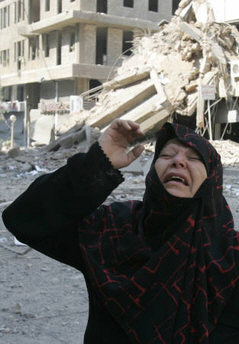
A Lebanese woman wails after looking at the wreckage of her apartment, in a building, that was demolished by the Israeli attacks in southern Beirut July 22, 2006. REUTERS/Issam Kobeisi (from Yahoo News)
http://photos1.blogger.com/blogger/4399 ... woman2.jpg
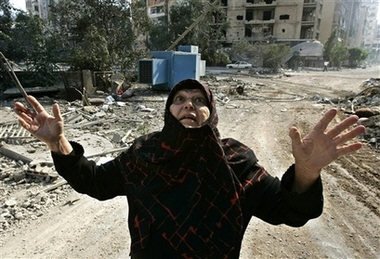
A Lebanese woman reacts at the destruction after she came to inspect her house in the suburbs of Beirut, Lebanon, Saturday, Aug. 5, 2006, after Israeli warplanes repeatedly bombed the area overnight.(AP Photo/Hussein Malla) (from Yahoo News)
http://photos1.blogger.com/blogger/4399 ... man3.0.jpg
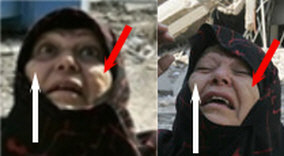
Same clothes, same scar on her left cheek, same mark under her right eye. Two pictures of the same woman, maybe even taken on the same day.
So, what gives?
Update 10.30pm. The BBC is currently using that second picture. Twice. On one page.
http://photos1.blogger.com/blogger/4399 ... bbcleb.jpg
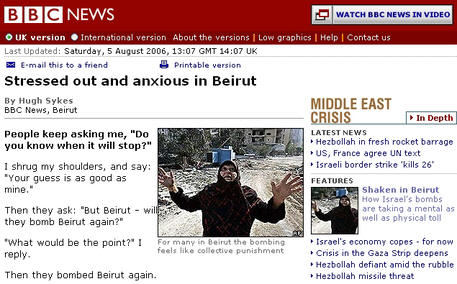
(Hat tip David from the Cabarfeidh Pages)
Update Aug 7, 3.45pm. Stealth edit from the BBC:
http://photos1.blogger.com/blogger/4399 ... bcleb2.jpg
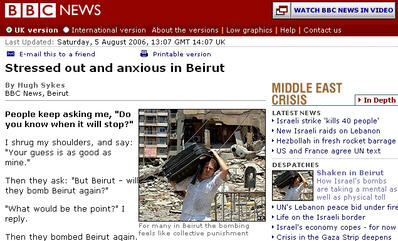
(Hat tip David again)
posted by DFH at 3:12 PM
- Arch
- Level 1 Star User
- Posts: 862
- Joined: Wed Nov 05, 2003 7:05 am
Biased Journalism is an american trait
http://www.aljazeerah.info/Hassan%20El-Najjar/american_foreign_policy_in_the_m.htm
http://www.aljazeerah.info/Hassan%20El-Najjar/american_foreign_policy_in_the_m.htm
Since September 11, 2001, American media, particularly major TV networks, newspapers and magazines, have been busy trying to cover the American government response and how the American people are coping with the tragedy. During the first week, most of them tried to answer the question, “why do they hate us?” However, they did not continue in that direction because it would lead them to a review of the American foreign policy in the Middle East. And if they did that, they may end up criticizing or blaming that policy for what happened. Moreover, such a review may implicate the media because of their biased coverage of the Middle Eastern problems. That is why they have concentrated on the government response that they call, “America strikes back.”
This article attempts to answer that dodged question. However, in no way, the reckless and biased American foreign policy justifies for victims to victimize others, particularly innocent civilians. The fatal mistake that has led to this foreign policy fiasco has been compromising a major principle the founding fathers insisted upon, that is, maintaining a system of checks and balances in government. Only then, bias would be minimum and conflict of interests would be avoided. But successive administrations have recklessly compromised that principle, Since the 1960s. This was evident in dealing with the Middle East, particularly concerning the Palestinian problem, the Arab-Israeli conflict, the Iraqi-Kuwaiti crisis, and the Afghani tragedy. In each administration, pro-Israel experts would be appointed to major decision-making positions in the National Security Council, the Department of State, the Department of Defense, and other major government agencies. These appointments have never been counterbalanced with appointment of an equal number of Arab and Muslim Americans in the same departments. Had this happened, the system of checks and balances would be in place, and we would have a fair and balanced foreign policy in the Middle East. However, in the absence of that, the pro-Israel experts kept recommending policies that only serve Israeli aggressive policies, and consequently harming Arabs and Muslims, particularly Palestinians. The end outcome has been the continuously rising anti-American sentiments in that region of the world.
I have an attitude and I am not afraid to use it.
-
Cragg - Level 1 Star User
- Posts: 659
- Joined: Sat Jun 10, 2006 12:57 pm
LOL, ur source ALJazeerah on bias !!? LOL.. sorry but,LOL
LOL, and your source is al-jazeera !!!! lol, on America !!? LOL. you are good.
BTW, I dont think there are any people who are not biased, leave alone those of the people who are jouralists. They get to see a lot of stuff that we, the general public do not get to see. They do get to give in to their feelings twds what they believe in, at some point.
This guy Hajj happens to be a Lebbanese and will certainly have anger, fear and the rest of the stuff that goes with his country being bombarded, more so by a zionist nation. It is not any other ' muslim' nation (If what I am saying is not true, you as a muslim would condemn mumbai blasts, would condemn the daily barrage of suicide bombings of the civilians in Iraq by either shias or sunnis, those of the regular-feature-attacks that happen in Israel, again on civilians) but a zionist nation which is more powereful, more advanced..The hatred has been fed into against the jews since birth? or is it before? I heard that it is almost universal? I dont know yet..
What intrigues me is why is there so much hatred twds Jews? Hitler had. To the extent that he had to have concentration camps to annihilate them: men, women, children in the most despicable ways humanity ever knew. Most Muslims have it.. I am told. Jews themselves underplay their religious beliefs in public.. again I am told.
Yet, Jews are supposed to be one of the most intelligent of the human species.
Cragg wrote:Biased Journalism is an american trait
http://www.aljazeerah.info/Hassan%20El-Najjar/american_foreign_policy_in_the_m.htm
BTW, I dont think there are any people who are not biased, leave alone those of the people who are jouralists. They get to see a lot of stuff that we, the general public do not get to see. They do get to give in to their feelings twds what they believe in, at some point.
This guy Hajj happens to be a Lebbanese and will certainly have anger, fear and the rest of the stuff that goes with his country being bombarded, more so by a zionist nation. It is not any other ' muslim' nation (If what I am saying is not true, you as a muslim would condemn mumbai blasts, would condemn the daily barrage of suicide bombings of the civilians in Iraq by either shias or sunnis, those of the regular-feature-attacks that happen in Israel, again on civilians) but a zionist nation which is more powereful, more advanced..The hatred has been fed into against the jews since birth? or is it before? I heard that it is almost universal? I dont know yet..
What intrigues me is why is there so much hatred twds Jews? Hitler had. To the extent that he had to have concentration camps to annihilate them: men, women, children in the most despicable ways humanity ever knew. Most Muslims have it.. I am told. Jews themselves underplay their religious beliefs in public.. again I am told.
Yet, Jews are supposed to be one of the most intelligent of the human species.
- Arch
- Level 1 Star User
- Posts: 862
- Joined: Wed Nov 05, 2003 7:05 am
Re: LOL, ur source ALJazeerah on bias !!? LOL.. sorry but,LO
Arch wrote:LOL, and your source is al-jazeera !!!! lol, on America !!? LOL. you are good.Cragg wrote:Biased Journalism is an american trait
http://www.aljazeerah.info/Hassan%20El-Najjar/american_foreign_policy_in_the_m.htm
BTW, I dont think there are any people who are not biased, leave alone those of the people who are jouralists. They get to see a lot of stuff that we, the general public do not get to see. They do get to give in to their feelings twds what they believe in, at some point.
Yet, Jews are supposed to be one of the most intelligent of the human species.
Offcourse all are biased but why sometimes try using ur mind to understand .
And for hatred towards Jews
 read history .
They are the only people disowned by their own messiah. Do u need anymore explanation.
I have an attitude and I am not afraid to use it.
-
Cragg - Level 1 Star User
- Posts: 659
- Joined: Sat Jun 10, 2006 12:57 pm
Re: LOL, ur source ALJazeerah on bias !!? LOL.. sorry but,LO
Cragg wrote:
Offcourse all are biased but why sometimes try using ur mind to understand .
dont understand what you r trying to say here other than you being rude.
Cragg wrote:
And for hatred towards Jews
They are the only people disowned by their own messiah. Do u need anymore explanation.
Even if they have been 'disowned' by their own messiah, why should muslims hate the jews? I dont see your point. Btw, I did catch up on my history about jews, muslims and christians. It still does not make sense why they shud be so hated by muslims in this era and age !
again a simpler question to my muslim brethren in hyd: why do some muslims hate non-muslims so much that they even are willing to forego not only their lives but their childrens' lives too by way of using their bodies on suicide missions? Just so that they can kill non-muslims? Why so much hatred? Let us not equate other fundamental religious groups here for the simple reason that they differ, in the present times, in terms of suicide bombings all over the world.
- Arch
- Level 1 Star User
- Posts: 862
- Joined: Wed Nov 05, 2003 7:05 am
biased journalism;Isreal's 'disproportiante' attack'.
an excellent article on 'biased journalism in America and on Isreal's 'disproportiante' attack'.
http://www.suntimes.com/output/steyn/cs ... eyn06.html
http://www.suntimes.com/output/steyn/cs ... eyn06.html
Advocates of 'proportion' are just unbalanced
August 6, 2006
BY MARK STEYN SUN-TIMES COLUMNIST
"Disproportion" is the concept of the moment. Do you know how to play? Let's say 150 missiles are lobbed at northern Israel from the Lebanese village of Qana and the Israelis respond with missiles of their own that kill 28 people. Whoa, man, that's way "disproportionate."
But let's say you're a northwestern American municipality -- Seattle, for example -- and you haven't lobbed missiles at anybody, but a Muslim male shows up anyway and shoots six Jewish women, one of whom tries to flee up the stairs, but he spots her, leans over the railing, fires again and kills her. He describes himself as "an American Muslim angry at Israel" and tells 911 dispatchers: ''These are Jews. I want these Jews to get out. I'm tired of getting pushed around, and our people getting pushed around by the situation in the Middle East.''
Well, that's apparently entirely "proportionate," so "proportionate" that the event is barely reported in the American media, or (if it is) it's portrayed as some kind of random convenience-store drive-by shooting. Pamela Waechter's killer informed his victims that "I'm only doing this for a statement," but the world couldn't be less interested in his statement, not compared to his lawyer's statement that he's suffering from "bipolar disorder.'' And the local FBI guy, like the Mounties in Toronto a month or so back, took the usual no-jihad-to-see-here line. ''There's nothing to indicate it's terrorism related,'' said Special Assistant Agent-In-Charge David Gomez. In America, terrorism is like dentistry and hairdressing: It doesn't count unless you're officially credentialed.
On the other hand, when a drunk movie star gets pulled over and starts unburdening himself of various theories about "f---ing Jews," hold the front page! That is so totally "disproportionate" it's the biggest story of the moment. The head of America's most prominent Jewish organization will talk about nothing else for days on end, he and the media too tied up dealing with Mel Gibson's ruminations on "f---ing Jews" to bother with footling peripheral stories about actual f---ing Jews murdered for no other reason than because they're f---ing Jews.
On the other other hand, when the leader of Hezbollah, Hassan Nasrallah, announces that if Jews "all gather in Israel, it will save us the trouble of going after them worldwide,'' that's not in the least "disproportionate.'' When President Ahmadinejad of Iran visits Malaysia and declares, apropos Lebanon, that "although the main solution is for the elimination of the Zionist regime, at this stage an immediate cease-fire must be implemented," well, that's just a bit of mildly overheated rhetoric prefacing what's otherwise a very helpful outline of a viable peace process: (Stage One) Please don't keep degrading our infrastructure until (Stage Two) we've got the capacity to nuke you.
Right now, Israel's best chance of any decent press would seem to be if Mel Gibson flies in and bawls out his waiter as a "f---ing Jew.''
What can we deduce from these various acts, proportionate and not so? If you talk to European officials, they'll tell you privately that that Seattle shooting is the way of the future -- that every now and then in Seattle or Sydney, Madrid or Manchester, someone will die because they went to a community center, got on the bus, showed up for work . . and a jihadist was there. But they're confident that they can hold it to what the British security services cynically called, at the height of the Northern Ireland ''Troubles,'' ''an acceptable level of violence'' -- i.e., it will all be kept ''proportionate.'' Tough for Pam Waechter's friends and family, but there won't be too many of them.
I wonder if they're right to be that complacent. The duke of Wellington, the great British soldier-politician, was born in Ireland, but, upon being described as an Irishman, remarked that a man could be born in a stable but it didn't make him a horse. That's the way many Muslims feel: Just because you're born in the filthy pigsty of the Western world doesn't make you a pig. What proportion of Muslims is hot for jihad? Well, it would be grossly insensitive and disproportionate to inquire. So instead we'll put it down to isolated phenomena like the supposed "bipolar disorder" of Pam Waechter's killer.
In the struggle between America and global Islam, it's the geopolitical bipolar disorder that matters. Clearly, from his own statements about "our people," for Pam Waechter's killer his Muslim identity ultimately transcended his American one. That's what connects him to what's happening in southern Lebanon: a pan-Islamist identity that overrides national citizenship whether in the Pacific Northwest or the Levant. Not for all Muslims, but for enough that things will get mighty "disproportionate" before they're through.
Twenty-eight dead civilians in a village from which 150 Katyusha rockets have been launched against Israel doesn't seem "disproportionate" to me. What's "disproportionate" is the idea that civilian life should be allowed to proceed normally in what is, in fact, a terrorist launching platform.
But, when an army goes to war against a terrorist organization, it's like watching the Red Sox play Andre Agassi: Each side is being held to its own set of rules. When Hezbollah launches rockets into Israeli residential neighborhoods with the intention of killing random civilians, that's fine because, after all, they're terrorists and that's what terrorists do. But when, in the course of trying to resist the terrorists, Israel unintentionally kills civilians, that's an appalling act of savagery. Speaking at West Point in 2002, President Bush observed: "Deterrence -- the promise of massive retaliation against nations -- means nothing against shadowy terrorist networks with no nation or citizens to defend." Actually, it's worse than that. In Hezbollahstan, the deaths of its citizens works to its strategic advantage: Dead Israelis are good news but dead Lebanese are even better, at least on the important battlefield of world opinion. The meta-narrative, as they say, is consistent through the media's Hez-one-they-made-earlier coverage, and the recent Supreme Court judgment, and EU-U.N. efforts to play "honest broker" between a sovereign state and a genocidal global terror conglomerate: All these things enhance the status of Islamist terror and thus will lead to more of it, and ever more "disproportionately."
- Arch
- Level 1 Star User
- Posts: 862
- Joined: Wed Nov 05, 2003 7:05 am
biased journalism;Isreal's 'disproportiante' attack'.
an excellent article on 'biased journalism in America and on Isreal's 'disproportiante' attack'.
http://www.suntimes.com/output/steyn/cs ... eyn06.html
http://www.suntimes.com/output/steyn/cs ... eyn06.html
Advocates of 'proportion' are just unbalanced
August 6, 2006
BY MARK STEYN SUN-TIMES COLUMNIST
"Disproportion" is the concept of the moment. Do you know how to play? Let's say 150 missiles are lobbed at northern Israel from the Lebanese village of Qana and the Israelis respond with missiles of their own that kill 28 people. Whoa, man, that's way "disproportionate."
But let's say you're a northwestern American municipality -- Seattle, for example -- and you haven't lobbed missiles at anybody, but a Muslim male shows up anyway and shoots six Jewish women, one of whom tries to flee up the stairs, but he spots her, leans over the railing, fires again and kills her. He describes himself as "an American Muslim angry at Israel" and tells 911 dispatchers: ''These are Jews. I want these Jews to get out. I'm tired of getting pushed around, and our people getting pushed around by the situation in the Middle East.''
Well, that's apparently entirely "proportionate," so "proportionate" that the event is barely reported in the American media, or (if it is) it's portrayed as some kind of random convenience-store drive-by shooting. Pamela Waechter's killer informed his victims that "I'm only doing this for a statement," but the world couldn't be less interested in his statement, not compared to his lawyer's statement that he's suffering from "bipolar disorder.'' And the local FBI guy, like the Mounties in Toronto a month or so back, took the usual no-jihad-to-see-here line. ''There's nothing to indicate it's terrorism related,'' said Special Assistant Agent-In-Charge David Gomez. In America, terrorism is like dentistry and hairdressing: It doesn't count unless you're officially credentialed.
On the other hand, when a drunk movie star gets pulled over and starts unburdening himself of various theories about "f---ing Jews," hold the front page! That is so totally "disproportionate" it's the biggest story of the moment. The head of America's most prominent Jewish organization will talk about nothing else for days on end, he and the media too tied up dealing with Mel Gibson's ruminations on "f---ing Jews" to bother with footling peripheral stories about actual f---ing Jews murdered for no other reason than because they're f---ing Jews.
On the other other hand, when the leader of Hezbollah, Hassan Nasrallah, announces that if Jews "all gather in Israel, it will save us the trouble of going after them worldwide,'' that's not in the least "disproportionate.'' When President Ahmadinejad of Iran visits Malaysia and declares, apropos Lebanon, that "although the main solution is for the elimination of the Zionist regime, at this stage an immediate cease-fire must be implemented," well, that's just a bit of mildly overheated rhetoric prefacing what's otherwise a very helpful outline of a viable peace process: (Stage One) Please don't keep degrading our infrastructure until (Stage Two) we've got the capacity to nuke you.
Right now, Israel's best chance of any decent press would seem to be if Mel Gibson flies in and bawls out his waiter as a "f---ing Jew.''
What can we deduce from these various acts, proportionate and not so? If you talk to European officials, they'll tell you privately that that Seattle shooting is the way of the future -- that every now and then in Seattle or Sydney, Madrid or Manchester, someone will die because they went to a community center, got on the bus, showed up for work . . and a jihadist was there. But they're confident that they can hold it to what the British security services cynically called, at the height of the Northern Ireland ''Troubles,'' ''an acceptable level of violence'' -- i.e., it will all be kept ''proportionate.'' Tough for Pam Waechter's friends and family, but there won't be too many of them.
I wonder if they're right to be that complacent. The duke of Wellington, the great British soldier-politician, was born in Ireland, but, upon being described as an Irishman, remarked that a man could be born in a stable but it didn't make him a horse. That's the way many Muslims feel: Just because you're born in the filthy pigsty of the Western world doesn't make you a pig. What proportion of Muslims is hot for jihad? Well, it would be grossly insensitive and disproportionate to inquire. So instead we'll put it down to isolated phenomena like the supposed "bipolar disorder" of Pam Waechter's killer.
In the struggle between America and global Islam, it's the geopolitical bipolar disorder that matters. Clearly, from his own statements about "our people," for Pam Waechter's killer his Muslim identity ultimately transcended his American one. That's what connects him to what's happening in southern Lebanon: a pan-Islamist identity that overrides national citizenship whether in the Pacific Northwest or the Levant. Not for all Muslims, but for enough that things will get mighty "disproportionate" before they're through.
Twenty-eight dead civilians in a village from which 150 Katyusha rockets have been launched against Israel doesn't seem "disproportionate" to me. What's "disproportionate" is the idea that civilian life should be allowed to proceed normally in what is, in fact, a terrorist launching platform.
But, when an army goes to war against a terrorist organization, it's like watching the Red Sox play Andre Agassi: Each side is being held to its own set of rules. When Hezbollah launches rockets into Israeli residential neighborhoods with the intention of killing random civilians, that's fine because, after all, they're terrorists and that's what terrorists do. But when, in the course of trying to resist the terrorists, Israel unintentionally kills civilians, that's an appalling act of savagery. Speaking at West Point in 2002, President Bush observed: "Deterrence -- the promise of massive retaliation against nations -- means nothing against shadowy terrorist networks with no nation or citizens to defend." Actually, it's worse than that. In Hezbollahstan, the deaths of its citizens works to its strategic advantage: Dead Israelis are good news but dead Lebanese are even better, at least on the important battlefield of world opinion. The meta-narrative, as they say, is consistent through the media's Hez-one-they-made-earlier coverage, and the recent Supreme Court judgment, and EU-U.N. efforts to play "honest broker" between a sovereign state and a genocidal global terror conglomerate: All these things enhance the status of Islamist terror and thus will lead to more of it, and ever more "disproportionately."
- Arch
- Level 1 Star User
- Posts: 862
- Joined: Wed Nov 05, 2003 7:05 am
Cragg wrote:Biased Journalism is an american trait
http://www.aljazeerah.info/Hassan%20El-Najjar/american_foreign_policy_in_the_m.htmSince September 11, 2001, .... region of the world.
so the US hates muslims and thats why there's a war "on Islam" due to the innumerous jews appointed to positions of power?
please clarify to me Cragg, I'm trying to grasp at the content of this journalism.

2001 AV6 AT
-

mango - Registered User
- Posts: 151
- Joined: Fri Apr 02, 2004 2:15 am
- Location: kahleeforneeya
Can we stop to think?
Let me start off by saying that I do NOT support Hizbollah in the least bit nor the intentions of some of these Arab nations to wipe Israel of the face of the earth. But for all those pointing their fingers at these Arab nations, do remember that Israel had the same intentions. Here are some samples:
Some of David Ben Gurion's quotes:
'We must expel Arabs and take their places'
"We should prepare to go over to the offensive. Our aim is to smash Lebanon, Trans-Jordan, and Syria. The weak point is Lebanon, for the Moslem regime is artificial and easy for us to undermine. We shall establish a Christian state there, and then we will smash the Arab Legion, eliminate Trans-Jordan; Syria will fall to us. We then bomb and move on and take Port Said, Alexandria and Sinai."
"We have to kill all the Palestinians unless they are resigned to live here as slaves." Chairman Heilbrun of the Committee for the Re-election of General Shlomo Lahat, the mayor of Tel Aviv, October 1983
"We must use terror, assassination, intimidation, land confiscation, and the cutting of all social services to rid the Galilee of its Arab population." Israel Koenig, "The Koenig Memorandum"
Rabin's description of the conquest of Lydda, after the completion of Plan Dalet. "We shall reduce the Arab population to a community of woodcutters and waiters" Uri Lubrani
"There was no such thing as Palestinians, they never existed." Golda Meir
"Every time we do something you tell me America will do this and will do that . . . I want to tell you something very clear: Don't worry about American pressure on Israel. We, the Jewish people, control America, and the Americans know it." Ariel Sharon
"Jewish blood and a goy's [gentile's] blood are not the same." Israeli Rabbi Yitzhak Ginsburg
Before others point out, I know that some of these quotes are quite beside the point - I just put them in as an insight into the Israeli viewpoint. And if you argue that these quotes have to been taken out of context, then yes, I agree that that is a possibility but certainly not ALL of them have been taken out of context.
My point of putting these quotes is not to say that because Israel wants to wipe out Palestine, it's okay for these countries to want to wipe out Israel. It is not okay. It's not okay for either country. But just wanted to point out that Israel is guilty of the same crime that you are accusing its enemies with.
Some of David Ben Gurion's quotes:
'We must expel Arabs and take their places'
"We should prepare to go over to the offensive. Our aim is to smash Lebanon, Trans-Jordan, and Syria. The weak point is Lebanon, for the Moslem regime is artificial and easy for us to undermine. We shall establish a Christian state there, and then we will smash the Arab Legion, eliminate Trans-Jordan; Syria will fall to us. We then bomb and move on and take Port Said, Alexandria and Sinai."
"We have to kill all the Palestinians unless they are resigned to live here as slaves." Chairman Heilbrun of the Committee for the Re-election of General Shlomo Lahat, the mayor of Tel Aviv, October 1983
"We must use terror, assassination, intimidation, land confiscation, and the cutting of all social services to rid the Galilee of its Arab population." Israel Koenig, "The Koenig Memorandum"
Rabin's description of the conquest of Lydda, after the completion of Plan Dalet. "We shall reduce the Arab population to a community of woodcutters and waiters" Uri Lubrani
"There was no such thing as Palestinians, they never existed." Golda Meir
"Every time we do something you tell me America will do this and will do that . . . I want to tell you something very clear: Don't worry about American pressure on Israel. We, the Jewish people, control America, and the Americans know it." Ariel Sharon
"Jewish blood and a goy's [gentile's] blood are not the same." Israeli Rabbi Yitzhak Ginsburg
Before others point out, I know that some of these quotes are quite beside the point - I just put them in as an insight into the Israeli viewpoint. And if you argue that these quotes have to been taken out of context, then yes, I agree that that is a possibility but certainly not ALL of them have been taken out of context.
My point of putting these quotes is not to say that because Israel wants to wipe out Palestine, it's okay for these countries to want to wipe out Israel. It is not okay. It's not okay for either country. But just wanted to point out that Israel is guilty of the same crime that you are accusing its enemies with.
- Ramya
- Registered User
- Posts: 7
- Joined: Thu Jun 08, 2006 10:40 am
And it ain't self-defense
And when one justifies Israel actions as self-defense then let us please note that Lebanon and the Lebanese popoluation will suffer for years to come because of this attack on their territory while Israel's security has not come under any threat because of the kidnapping of its soldiers. I don't suppoort the kidnapping, don't justify it at all - but what I'm saying is, when this kidnapping has no threat on Israeli security, how can it bombard a nation on the flimsy claim of self-defense.
Self-defense it has - with the US right behind it, giving it billions of dollars in support, supplying it with arms and weapons, making Israel's enemies its own and supressing any kind of opposition to Israel's actions.
How are we all conveniently forgetting how things were before 4 weeks? What about all hundreds of kidnappings and killings of Lebanese civilians and officials? What about the many many Lebanese wasting away their lives in Isreal prisons, without even being charged for any crimes. What about self-defense for Lebanon?
What about Lebanon's right to defend itself when Lebanese schools, hospitals, homes, orphanages, buildings, their very livelihood is destroyed? What about their right to self-defense when their mothers, fathers, brothers, sisters, children are killed before their very eyes for no fault of theirs?
But no, of course it's the prerogative of the US, Israel and the UK to defend themselves. Of course, other nations don't have equal rights silly. Aren't these the countries who decide which country is a terrorist state and which is not? Iraq was called a terrorist state (Ideologically and otherwise, Saddam Hussein was considered an enemy of Al Qaeda) hoarding WMD's which have been so well hidden that they haven't been found even till now while Pakistan is not a terrorist state and is a paragon of peace. Right!
I digress. Coming back to the point, before supporting Israel's right to defend itself, let us not ignore Israel's contribution towards making the region a perennial war zone.
Let me conclude by saying that I do not support Hizbollah at all. And it is totally wrong in continuin to wage it's war and do what it's doing. At the same time, I feel sad to see so many people stand behind Israel as if it is a country that can do no wrong. This is an intractable problem and neither side is doing the right thing. Their current actions are only complicating matters and the ultimate victims in this tragedy are going to be innocent civilians.
Self-defense it has - with the US right behind it, giving it billions of dollars in support, supplying it with arms and weapons, making Israel's enemies its own and supressing any kind of opposition to Israel's actions.
How are we all conveniently forgetting how things were before 4 weeks? What about all hundreds of kidnappings and killings of Lebanese civilians and officials? What about the many many Lebanese wasting away their lives in Isreal prisons, without even being charged for any crimes. What about self-defense for Lebanon?
What about Lebanon's right to defend itself when Lebanese schools, hospitals, homes, orphanages, buildings, their very livelihood is destroyed? What about their right to self-defense when their mothers, fathers, brothers, sisters, children are killed before their very eyes for no fault of theirs?
But no, of course it's the prerogative of the US, Israel and the UK to defend themselves. Of course, other nations don't have equal rights silly. Aren't these the countries who decide which country is a terrorist state and which is not? Iraq was called a terrorist state (Ideologically and otherwise, Saddam Hussein was considered an enemy of Al Qaeda) hoarding WMD's which have been so well hidden that they haven't been found even till now while Pakistan is not a terrorist state and is a paragon of peace. Right!
I digress. Coming back to the point, before supporting Israel's right to defend itself, let us not ignore Israel's contribution towards making the region a perennial war zone.
Let me conclude by saying that I do not support Hizbollah at all. And it is totally wrong in continuin to wage it's war and do what it's doing. At the same time, I feel sad to see so many people stand behind Israel as if it is a country that can do no wrong. This is an intractable problem and neither side is doing the right thing. Their current actions are only complicating matters and the ultimate victims in this tragedy are going to be innocent civilians.
- Ramya
- Registered User
- Posts: 7
- Joined: Thu Jun 08, 2006 10:40 am
continuing in the same vein...
To continue on the topic of self-defense and deterrence, how did Israel achieve that by killing UN observors with their smart bombs and precision bombs? I guess, the same way they forwarded their self-defense ambitions by killing over 100 people in a UN refugee camp last year.
Oh, as for where all these Hizbollah rockets are falling, there have been no deaths due to Hizbollah rockets in the last 6 years, until this conflict started.
During this conflict, about 60% of Israeli deaths are soldiers whereas a majority of Lebanese deaths are civilians.
And also, maybe we should keep in mind that the Isaeli soldiers were captured on the Lebanon side of the border. Now how come no one questions what they were doing on the other side of the border?
Israel kills Palestinians on a daily basis, destroys their homes, schools, hospitals, infrastructure, all in the name of self-defense.
I know I have been less that coherent in this post but I am just so sad and so angry that people can still go about justifying Israeli actions with self-defense as an excuse!
Oh, as for where all these Hizbollah rockets are falling, there have been no deaths due to Hizbollah rockets in the last 6 years, until this conflict started.
During this conflict, about 60% of Israeli deaths are soldiers whereas a majority of Lebanese deaths are civilians.
And also, maybe we should keep in mind that the Isaeli soldiers were captured on the Lebanon side of the border. Now how come no one questions what they were doing on the other side of the border?
Israel kills Palestinians on a daily basis, destroys their homes, schools, hospitals, infrastructure, all in the name of self-defense.
I know I have been less that coherent in this post but I am just so sad and so angry that people can still go about justifying Israeli actions with self-defense as an excuse!
- Ramya
- Registered User
- Posts: 7
- Joined: Thu Jun 08, 2006 10:40 am
Re: continuing in the same vein...
Ramya wrote:To continue on the topic of self-defense and deterrence, how did Israel achieve that by killing UN observors with their smart bombs and precision bombs? I guess, the same way they forwarded their self-defense ambitions by killing over 100 people in a UN refugee camp last year.
Oh, as for where all these Hizbollah rockets are falling, there have been no deaths due to Hizbollah rockets in the last 6 years, until this conflict started.
During this conflict, about 60% of Israeli deaths are soldiers whereas a majority of Lebanese deaths are civilians.
And also, maybe we should keep in mind that the Isaeli soldiers were captured on the Lebanon side of the border. Now how come no one questions what they were doing on the other side of the border?
Israel kills Palestinians on a daily basis, destroys their homes, schools, hospitals, infrastructure, all in the name of self-defense.
I know I have been less that coherent in this post but I am just so sad and so angry that people can still go about justifying Israeli actions with self-defense as an excuse!
Hi Ramya
Well said. It is really painful to see the innocent Lebanese people suffer for no fault of theirs. Israel should grow up and learn to respect its neighbors. When it contributes to Lebanese industry and universities instead of shamelessly bombing it, people will start looking at it in better terms.
Hizbollah has a stated goal of destroying Israel. It doesn't stop until that is done. But Israel is doing nothing to isolate the rest of the crowd from this mad propaganda. In fact, it is helping the propaganda grow bigger.
-

vakibs - Registered User
- Posts: 245
- Joined: Wed Apr 06, 2005 2:56 pm
- Location: space-time fabric
c her
Arch shouted and laughed at craggs article posted
Wat do u think are u the judged out here to give decision to excepted.
Look at here wat she says that u cant refer al jazeera for discussion obviously biased when this news agency is highly reverred in arab world!!!!
Means directly telling arab and some muslims beleive in biased news and ultimately they are liar!
And now look wat the ---- her source are
look arch where ur bookmarked favourite gets the news from
Then y did LOLed on cragg's article
Couled be 2 reason either ur a or a
Chicago sun times - American news paper. u dont expect a popular american newspaper for a negative comment upon american policy. do u ?
a rarity
Ynet news - this wats there on its site
Ynetnews: The real Israel in real time
Part of Yedioth Group, Israel's largest media company, sister site to Israel's best web operation
An israeli website
Haaretz Haaretz was founded in Jerusalem in 1919 by a group of Zionist immigrants, mainly from Russia.
again an israeli daily
jerusalam post the names tells the story
again an israeli daily
she got 5 articles from the jpost during countering her argument.
wikepaidea the site where u can submit anythin and never can be taken for reference for a try do it for india sensitive search on wiki u'll get to know abt kashmir,....
With this u have been askin where the hezb missiles land.
u lost the credibility to do so.
u r utterly racist
u know wat jews racist bigot who call themselves Chosen People.
r u ?
think before laughin at others wat ur sources are
[/quote]
LOL, and your source is al-jazeera !!!! lol, on America !!? LOL. you are good.
Wat do u think are u the judged out here to give decision to excepted.
Look at here wat she says that u cant refer al jazeera for discussion obviously biased when this news agency is highly reverred in arab world!!!!
Means directly telling arab and some muslims beleive in biased news and ultimately they are liar!
And now look wat the ---- her source are
look arch where ur bookmarked favourite gets the news from
Then y did LOLed on cragg's article
Couled be 2 reason either ur a or a
Chicago sun times - American news paper. u dont expect a popular american newspaper for a negative comment upon american policy. do u ?
a rarity
Ynet news - this wats there on its site
Ynetnews: The real Israel in real time
Part of Yedioth Group, Israel's largest media company, sister site to Israel's best web operation
An israeli website
Haaretz Haaretz was founded in Jerusalem in 1919 by a group of Zionist immigrants, mainly from Russia.
again an israeli daily
jerusalam post the names tells the story
again an israeli daily
she got 5 articles from the jpost during countering her argument.
wikepaidea the site where u can submit anythin and never can be taken for reference for a try do it for india sensitive search on wiki u'll get to know abt kashmir,....
With this u have been askin where the hezb missiles land.
u lost the credibility to do so.
u r utterly racist
u know wat jews racist bigot who call themselves Chosen People.
r u ?
think before laughin at others wat ur sources are
[/quote]
- Wat arch!!!!!
- Registered User
- Posts: 382
- Joined: Sat Apr 15, 2006 7:43 pm
???
Photo feature
American way of justice and israel's view

Death count
Hezb's are rocket malfunctioning may be firing the wrong way.
say this it makes a good argument !!!!

wat are those innoscent children writing on those israeli shell and missiles

ooooh i c "with love to lebanese poor children or to poor arabs with choosen people or may be we love u through this way "
read it u'll find some rhetoric s as welll

oh jews settlers children are so loving. they r innoscent no arrogancy.
only love

American way of justice and israel's view
Death count
Hezb's are rocket malfunctioning may be firing the wrong way.
say this it makes a good argument !!!!
wat are those innoscent children writing on those israeli shell and missiles
ooooh i c "with love to lebanese poor children or to poor arabs with choosen people or may be we love u through this way "
read it u'll find some rhetoric s as welll
oh jews settlers children are so loving. they r innoscent no arrogancy.
only love
- is i am right on above post
- Registered User
- Posts: 382
- Joined: Sat Apr 15, 2006 7:43 pm
Blair's perspective on current situation......
http://www.outlookindia.com/full.asp?fodname=20060801&fname=tonyblair&sid=1
http://www.outlookindia.com/full.asp?fodname=20060801&fname=tonyblair&sid=1
God is a comedian playing to an audience too afraid to laugh. Voltaire, philosopher (1694-1778)
- akshay
- Registered User
- Posts: 262
- Joined: Sat Aug 27, 2005 3:58 pm
- Location: ramcastle
Return to The Hyderabadi Planet!
Who is online
Users browsing this forum: No registered users and 7 guests
ADVERTISEMENT
SHOUTBOX!
{{ todo.summary }}... expand »
{{ todo.text }}
« collapse
First | Prev |
1 2 3
{{current_page-1}} {{current_page}} {{current_page+1}}
{{last_page-2}} {{last_page-1}} {{last_page}}
| Next | Last
{{todos[0].name}}
{{todos[0].text}}
ADVERTISEMENT
This page was tagged for
muslimcomming in Hindustan
hezbullah hyderabad
chootya nawab
mulana and chote nawab comedy
israeli commandos landed near badawi on february 21, 1973
About Hyderabad
The Hyderabad Community
Improve fullhyd.com
More
Copyright © 2023 LRR Technologies (Hyderabad) Pvt Ltd. All rights reserved. fullhyd and fullhyderabad are registered trademarks of LRR Technologies (Hyderabad) Pvt Ltd. The textual, graphic, audio and audiovisual material in this site is protected by copyright law. You may not copy, distribute or use this material except as necessary for your personal, non-commercial use. Any trademarks are the properties of their respective owners.